Why Is Medicai the Best for Patient Sharing?
Many clinics still email CD-ROMs or wait for IT tickets just to move a single scan between departments. This slows diagnosis and leaves referring physicians without the images they need during the same visit.
By the end of this article you will know how Medicai's zero-footprint viewer, cloud PACS, and AI tools change that workflow, what pricing tiers exist, and which care settings benefit most from replacing scattered image storage with one connected platform.
What Is Medicai?
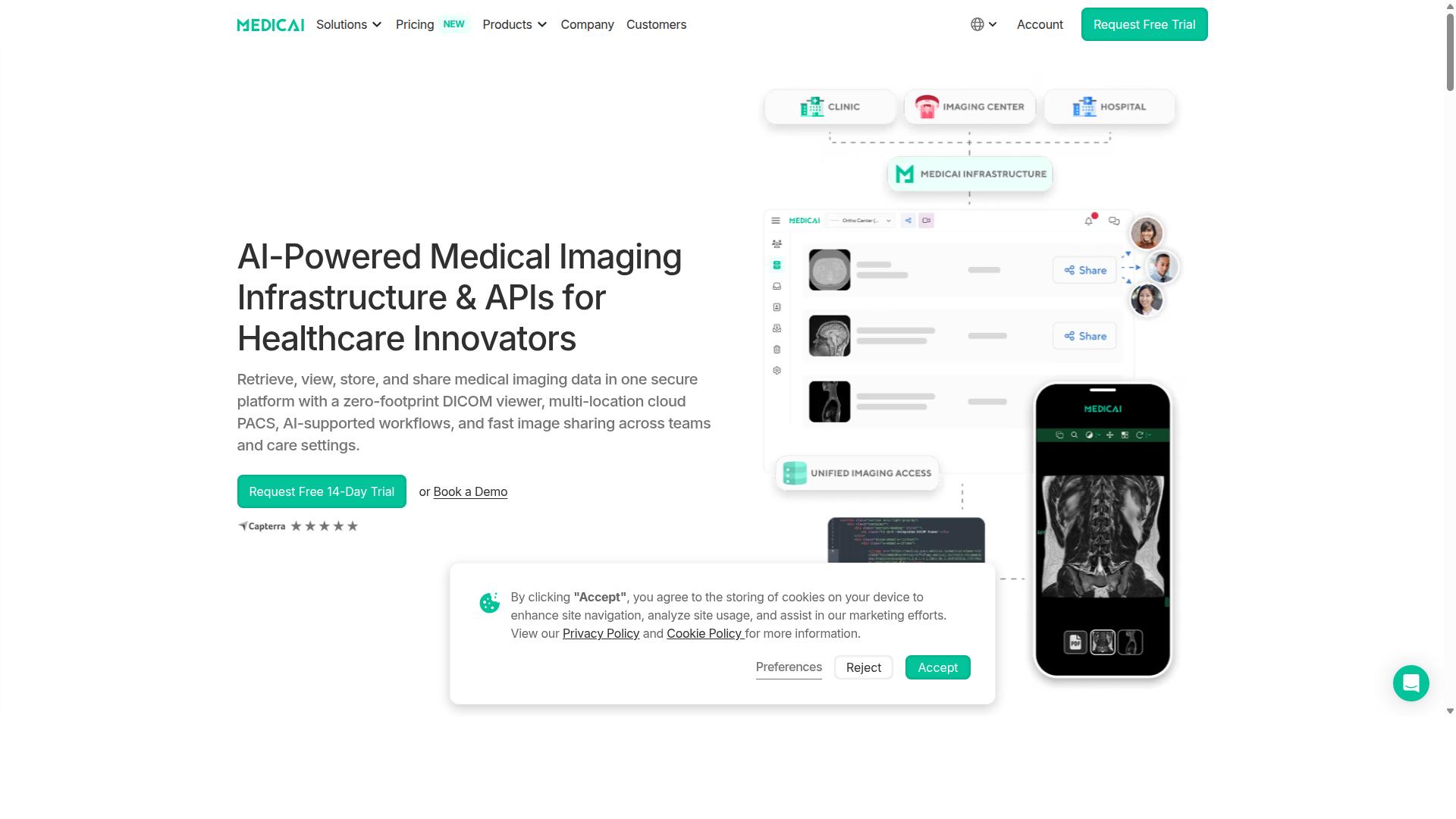
Medicai operates as a cloud-based medical imaging platform that consolidates retrieval, viewing, storage, and sharing functions into one secure environment. The platform combines multiple capabilities into a single workspace for healthcare teams.
Zero-footprint DICOM viewer technology allows clinicians to access images without local software installation. HIPAA and GDPR compliance standards protect patient data throughout every transaction.
FDA and CEE cleared status confirms regulatory approval for clinical use. Healthcare organizations benefit from verified security protocols that meet industry requirements.
The platform processes more than 1 million studies yearly while currently storing 1.7 million studies in its secure infrastructure. API transactions exceed 50 million annually, demonstrating system capacity for high-volume medical imaging workflows.
Healthcare providers rely on this infrastructure for consistent image exchange across different care settings. The platform supports multi-location cloud PACS architecture that maintains data accessibility regardless of geographic boundaries.
AI-supported workflows work together with existing radiology processes to enhance diagnostic efficiency. Fast image sharing capabilities reduce delays when specialists in different locations need immediate access to patient studies.
Medical imaging interoperability remains central to the platform design. Teams can exchange DICOM files securely while maintaining complete audit trails for regulatory compliance.
Why Medicai Is the Best for Patient Sharing
Patient sharing improves when institutions can exchange DICOM studies instantly without physical media or local software installs. Medical facilities need secure methods to move imaging data across different locations.
The Medical Image Exchange module handles encrypted transfer that protects patient information during every transmission. This approach eliminates the risks that come with mailing CDs or external drives between departments.
Consent management tools let providers track which studies patients have approved for sharing. Staff can verify permissions before any data leaves their system.
Every shared study generates audit trails that record who accessed the information and when. These records help organizations maintain compliance with healthcare regulations across the entire referral network.
Cloud platforms support interoperability between different PACS systems and hospital networks. This connectivity reduces delays that occur when specialists need images from outside facilities.
Healthcare teams benefit from real-time access to studies without installing additional software on their workstations. The system works across different devices while maintaining security standards.
Cross-institutional sharing becomes more reliable when platforms include zero-footprint viewers that function through standard web browsers. This reduces technical barriers for smaller clinics and remote locations.
Organizations can maintain data sovereignty through controlled access settings that determine which users see specific studies. These controls support multi-specialty collaboration while protecting sensitive information.
Quality assurance features help teams verify that shared images meet diagnostic standards before specialists review them. This step prevents delays from corrupted or incomplete data transfers.
The combination of encrypted transfer, consent tracking, and complete audit records creates a reliable foundation for patient sharing across healthcare networks. These capabilities address the main concerns that arise when facilities exchange medical imaging data.
Key Features and What Makes Medicai Stand Out
Three core capabilities differentiate Medicai from traditional PACS solutions. These features address the specific needs of patient sharing across hospitals, clinics, and specialist networks. Cross-institutional collaboration becomes possible when every participant can view and act on the same imaging data without delays or additional software requirements.
Real-time access matters because patient cases often involve multiple providers working from different locations. Medicai enables this access through browser-based tools that require no local installation. The platform handles encrypted transfer and maintains compliance with HIPAA and GDPR standards throughout every exchange.
Zero-Footprint DICOM Viewer
The viewer runs entirely in a browser, eliminating local installation and enabling instant access from any workstation or mobile device. This approach removes the barriers that traditionally slow down image sharing between institutions. Teams can review studies immediately rather than waiting for software setup or file transfers.
Over 300k visualizations of DICOM studies were completed in the last year using this browser-based system. The viewer supports multiplanar reconstruction and cine mode directly in the interface. These tools allow radiologists and referring physicians to examine studies from the same platform without switching applications.
Zero-footprint access supports telemedicine workflows and multi-specialty consultations. Any authorized user can open studies on standard hardware while maintaining data security through encrypted connections. This capability reduces the time between image acquisition and specialist review across different healthcare facilities.
Multi-Location Cloud PACS
A single cloud PACS instance can serve multiple physical sites while maintaining unified patient records. The Starter plan provides 500 GB of cloud storage with unlimited user accounts and no connected locations. The Standard plan offers 2 TB of storage with unlimited user accounts plus one connected location for direct integration.
Both storage tiers support patient sharing across different departments and external referral networks. Enterprise customers can add multiple connected locations as their network expands. All plans include HIPAA and GDPR compliance plus audit trails that track every study access and modification.
Cloud architecture removes the need for individual facilities to maintain separate PACS systems. Patient records remain accessible from any authorized location while preserving data sovereignty requirements. This structure supports the 70 clinics and hospitals currently using the platform for coordinated care.
AI-Supported Workflows
AI models integrated through the platform pre-process studies to flag anomalies and speed radiologist interpretation. Partnerships with Rayscape.ai, MD.ai, and Microsoft Azure bring specialized algorithms directly into the viewing environment. These integrations appear as part of the standard workflow rather than requiring separate software.
AI outputs display within the same viewer interface that handles DICOM studies. Radiologists receive flagged findings alongside the original images without additional steps or data transfers. This embedding supports faster turnaround times while maintaining clinical oversight of all AI recommendations.
The approach benefits cross-institutional collaboration because every participant sees the same AI-enhanced analysis. Specialists reviewing cases from different locations work from identical processed data. This consistency reduces interpretation differences that can occur when facilities use separate AI tools or viewing systems.
Pricing and Plans
Two subscription tiers accommodate practices of varying study volumes and number of connected sites. Starter and Standard plans provide monthly billing options that match different operational needs in medical imaging and patient sharing workflows.
Starter costs $249 per month. This tier includes 500 GB cloud storage, unlimited user accounts, and zero connected locations. The plan suits practices that handle smaller imaging volumes without requiring external site connections.
Standard costs $749 per month. This tier provides 2 TB cloud storage, unlimited user accounts, and one connected location. The plan supports practices that need to exchange medical images across a single external site while maintaining HIPAA compliance.
Enterprise plans offer custom pricing for organizations requiring multiple connected locations and external sites. These arrangements allow flexible storage allocations based on specific cross-institutional sharing demands.
Yearly billing reduces costs by 15 percent. Starter drops to $209 per month and Standard drops to $639 per month when paid annually. A 14-day trial of Starter features comes free without requiring a credit card.
DICOM Gateway setup requires a one-time fee of $1,000 per location. This infrastructure supports encrypted transfer between on-premise systems and the cloud platform for seamless image exchange.
Trust Signals
Independent verifications and compliance standards demonstrate platform reliability and security posture. HIPAA and GDPR compliance establishes the foundation for handling sensitive medical imaging data across borders.
These frameworks require strict controls on data access, encryption, and audit trails. FDA and CEE clearance adds another layer of validation for the image viewers that clinicians use daily.
Regulatory approval confirms that the software meets rigorous safety and performance standards for diagnostic use. OWASP security guidelines further shape how the system is built and tested.
Continuous monitoring through New Relic and PostHog integrations provides operational transparency. These tools track system performance and user interactions in real time.
Uptime SLA guarantees ensure that patient sharing workflows remain available when clinicians need them most. The combination of compliance certifications, cleared technology, and visible monitoring creates measurable trust for teams exchanging DICOM studies.
Who Should Use Medicai
Any healthcare provider needing secure, cross-site access to DICOM imaging will benefit from the platform. Medicai supports medical imaging exchange across multiple specialties and care settings. The platform enables encrypted transfer and real-time access without compromising data security.
Specialty clinics find particular value in Medicai capabilities. Orthopedics, neurology, and oncology practices can share patient imaging with referring physicians instantly. Radiology departments use the system for collaborative reads across locations.
Cardiology, ophthalmology, and ob-gyn providers access the same DICOM files from different sites. Pulmonology, dentistry, and gastroenterology teams coordinate care through the unified viewer. Each specialty maintains familiar workflows while gaining interoperability.
Hospitals integrate Medicai into existing PACS systems. Imaging centers use the platform to deliver studies to referring physicians. Specialty clinics connect with hospital networks through the cloud platform.
Virtual care providers and telemedicine platforms rely on Medicai for remote consultations. Teleradiology services distribute workload across reading radiologists. Tumor boards review cases from multiple institutions using the shared viewer.
Clinical trials benefit from centralized imaging review across study sites. Medical education organizations access anonymized cases for teaching purposes. Personal injury lawyers obtain required imaging documentation through secure patient portal access.
Patient sharing becomes seamless across all these user groups. The platform handles DICOM routing, permission management, and audit trails automatically. Healthcare IT teams appreciate the vendor-neutral approach that works with existing systems.
Final Verdict
Medicai consolidates fragmented imaging workflows into one compliant, globally accessible platform.
The system supports patient sharing through DICOM transfers, encrypted transfer protocols, and consent management features. These capabilities matter because medical teams need quick, secure access across locations and specialties.
Zero-footprint image viewer technology allows any authorized user to review studies without installing software. This approach reduces technical barriers for referring physicians and specialists who need immediate access to imaging results.
Cross-institutional collaboration becomes practical when all parties work from the same cloud platform. The vendor neutral archive structure ensures that imaging data remains accessible regardless of which PACS systems originally captured the studies.
Real-time access and audit trails provide the visibility healthcare organizations require for compliance and coordination. Mobile access extends these benefits beyond hospital walls to support telemedicine and remote consultation workflows.
Healthcare IT teams can connect Medicai to existing systems through integration API capabilities that support FHIR and HL7 standards. This interoperability reduces manual data handling and improves workflow efficiency across multi-specialty environments.
Medicai serves hospitals, clinics, and imaging centers that need reliable patient sharing infrastructure. The platform addresses the core requirements of HIPAA compliance, data security, and scalable image exchange without requiring extensive on-premise hardware investments.
Interested readers can contact [email protected] or call +1 (832) 220 1035 for USA inquiries. European customers reach the same team at +40 316 305 875. Both numbers connect callers directly to sales representatives who arrange tailored demonstrations based on specific organizational needs.
Recommended Resources: